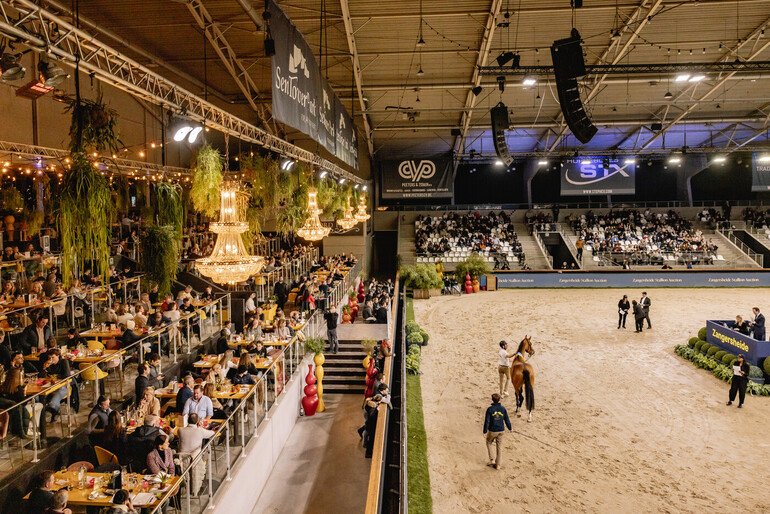

From February 25 - March 1, 2026, Sentower Park in Limburg will once again be dressed in Zangersheide’s distinctive blue and yellow when top sport and elite breeding converge during ‘The Zangersheide International’.
"Not only is 'The Zangersheide International' an incredible 3* competition where we welcome the best riders in the world, but also the breeding, for which this region is very well-known, will be extensively highlighted. The spring stallion selection of Studbook Zangersheide is once again organized at Sentower Park and will be complemented by a very exclusive stallion auction, Saturday February 28th, where the very best young approved stallions will be offered!" says Judy Ann Melchior.
The stallion licensing begins on Thursday, February 26, ahead of Saturday evening’s auction. In total, 133 young stallion candidates from nine different studbooks will be presented for inspection. The group consists of 108 stallions born in 2023 and 25 born in 2022. Prior to the approval, each stallion undergoes a full clinical and radiographic examination. They are then presented to the international jury consisting of Eric Levallois, Tim Rieskamp-Goedeking and Stijn van Campenhout, who first assess conformation, correctness and movement in hand on hard ground.
The free jumping begins on Friday morning and continues on Saturday, after which the jury will determine which stallions have earned their approval. From this group, a selection of the absolute highlights will be chosen to go under the hammer in the highly acclaimed Zangersheide Stallion Auction 2026.
The 2026 selection reflects both established sires and a rising generation of younger stallions. In total, 75 different sires are represented. Emerald leads numerically with eleven sons presented, marking the third consecutive year he tops the list. Chacco-Blue follows with nine offspring. Dourkhan Hero Z, despite being a relatively young sire, makes a powerful statement with seven sons, and the most significant presence among the younger generation of stallions. Don’t Touch Tiji Hero, Ermitage Kalone and Orak d’Hamwyck each have four sons entered, while Aganix du Seigneur Z, Chacoon Blue, Dominator 2000 Z and Heartbreaker are represented by three. On the maternal side, Diamant de Semilly, Baloubet du Rouet, Untouchable, Cornet Obolensky and Darco each appear three times as damsires. The data illustrates a clear pattern: modern performance sires dominate the paternal side, while established foundation stallions continue to anchor the maternal side. More than 95 different damlines are represented across the 133 stallions.
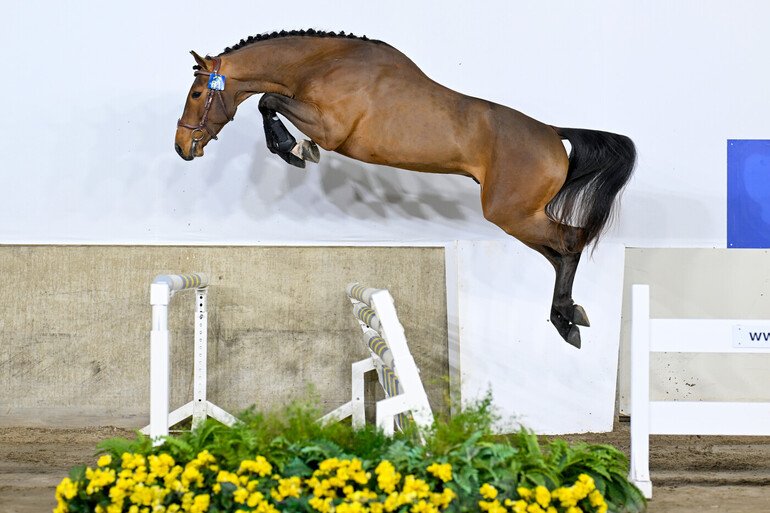
La dimension internationale du Zangersheide International s’étend bien au-delà du sport en piste, et se manifeste tout autant dans l’approbation des étalons elle-même.
Avec 133 étalons présentés, l’approbation 2026 reflète une fois encore à la fois concentration et rayonnement mondial, une combinaison devenue caractéristique de Zangersheide. Neuf stud-books sont représentés, Zangersheide constituant l’ossature avec 67,7 %, suivi du BWP avec 13,5 %. Des éleveurs de dix pays différents sont représentés. Les éleveurs belges représentent 50,8 %, suivis des Pays-Bas avec 22,7 % et de l’Allemagne avec 18,9 %. L’Italie, l’Espagne, la France, la Pologne, la Suisse, l’Autriche et la Hongrie sont également représentées. La Belgique fournit un peu plus de la moitié des candidats, confirmant son rôle central continu dans l’élevage moderne de chevaux de saut d’obstacles. Parallèlement, près de la moitié du lot est élevé à l’étranger, soulignant l’attrait international de l’approbation.
La propriété présente une répartition géographique encore plus large, avec des propriétaires issus de 16 pays différents. Si les éleveurs belges représentent plus de la moitié des inscriptions, la propriété belge constitue 43,6 % du lot. Les Pays-Bas suivent avec 32 étalons (24,1 %), l’Allemagne avec 26 (19,5 %), et l’Italie ainsi que la Grande-Bretagne avec trois chacun. Onze autres pays comptent des inscriptions individuelles, dont le Chili, le Brésil, le Panama, la Suède et la Roumanie, illustrant les investissements transfrontaliers continus dans la génétique du saut d’obstacles.